
Artificial intelligence is no longer just evolving, it is fundamentally transforming how organizations operate. In 2026, the rise of agentic AI marks a major shift from passive AI tools to proactive, goal-driven digital agents. Unlike traditional AI systems that respond to prompts, agentic AI systems can reason, plan, act, and coordinate complex workflows with minimal human intervention.
For enterprise leaders, technology strategists, and digital transformation teams, adopting agentic AI in 2026 is becoming a competitive necessity rather than an experimental initiative.
What Is Agentic AI?

Agentic AI refers to autonomous AI systems capable of pursuing defined objectives by planning multi-step actions, using tools, interacting with APIs, adapting to dynamic data, and executing tasks independently.
Key characteristics include:
- Multi-step planning and reasoning
- Tool and API integration
- Context awareness and memory
- Adaptive decision-making
- Outcome-oriented execution
This marks a significant evolution from generative AI systems that primarily produce text or content. Agentic AI goes beyond generation, it performs.
Why 2026 Is the Inflection Point for Agentic AI Adoption
Enterprise Integration at Scale
By 2026, agentic AI is being embedded directly into enterprise platforms rather than deployed as standalone tools. Organizations are integrating autonomous agents into ERP systems, CRM platforms, supply chains, IT service management, and finance operations.
The shift is clear: businesses are no longer experimenting, they are operationalizing.
Transition from Pilots to Production
Over the past two years, many companies ran limited AI pilots. In 2026, those pilots are scaling into production-grade systems with governance frameworks, measurable KPIs, and executive sponsorship.
Agentic AI is now tied to revenue growth, cost optimization, operational efficiency, and customer experience transformation.
Maturing AI Infrastructure
Improvements in large language models, multimodal AI, orchestration frameworks, and enterprise APIs have made autonomous agents more reliable and deployable. Cloud-native architectures and API-first ecosystems allow agents to securely interact across enterprise systems.
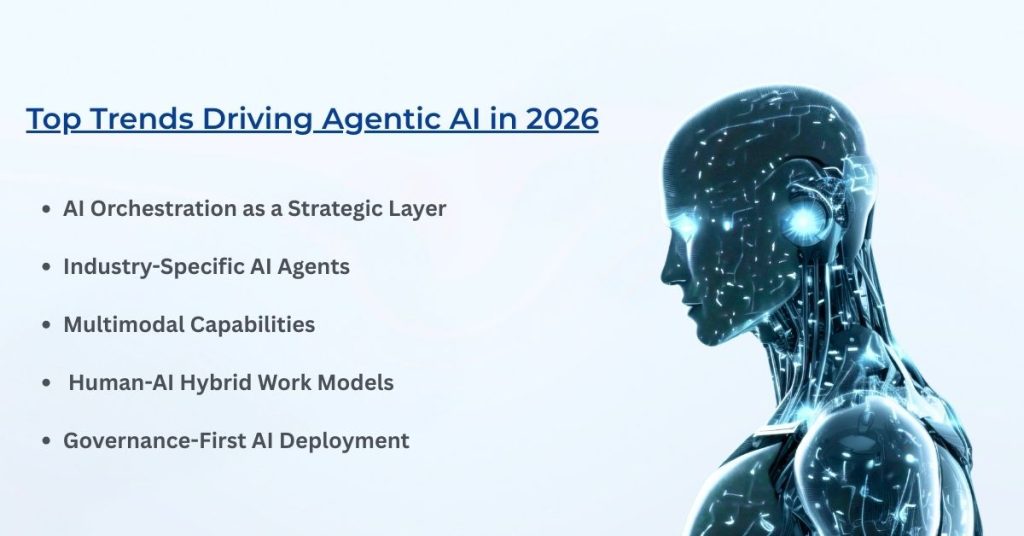
Top Trends Driving Agentic AI in 2026
1. AI Orchestration as a Strategic Layer
Agentic AI requires coordination. Orchestration platforms manage task delegation, tool access, memory handling, governance rules, and safety controls. This orchestration layer acts as the operating backbone for autonomous digital agents.
2. Industry-Specific AI Agents
Generic AI agents are giving way to domain-trained agents tailored for industries such as:
- Banking and financial services
- Insurance
- Manufacturing
- Healthcare
- Retail and e-commerce
These specialized agents understand regulatory requirements, business logic, and industry terminology, improving accuracy and compliance.
3. Multimodal Capabilities
Agentic AI systems now process and respond to multiple data types, including:
- Text
- Images
- Audio
- Structured data
- Sensor and IoT feeds
This enables broader use cases, such as automated inspections, fraud detection, predictive maintenance, and real-time logistics optimization.
4. Human-AI Hybrid Work Models
Rather than replacing employees, agentic AI augments them. Organizations are redefining roles to include AI supervisors, agent managers, and workflow strategists.
The future workforce is hybrid: humans focus on strategy and exception handling, while agents execute repeatable and structured tasks.
5. Governance-First AI Deployment
With increased autonomy comes increased risk. Enterprises are implementing:
- Role-based access controls
- Audit trails
- Explainability frameworks
- Human-in-the-loop checkpoints
- Ethical AI review boards
Governance is no longer optional, it is foundational.
Business Benefits of Adopting Agentic AI
Increased Productivity
Autonomous agents can manage repetitive workflows, coordinate tasks across systems, and reduce manual effort. This allows employees to focus on high-value activities such as innovation and strategic planning.
Operational Cost Optimization
By reducing manual interventions and improving process accuracy, agentic AI helps lower operational costs across finance, HR, IT, and customer service functions.
Faster Decision-Making
Agentic AI systems connected to real-time data sources can analyze, decide, and execute instantly. This improves responsiveness in dynamic environments such as supply chain operations and financial markets.
Enhanced Customer Experience
Autonomous agents can resolve support tickets, personalize communications, anticipate needs, and coordinate backend actions without delays.
Key Challenges in Agentic AI Adoption
Despite its promise, agentic AI adoption requires careful planning.
Governance and Compliance Risks
Autonomous systems making decisions must comply with regulations, especially in finance, healthcare, and government sectors. Organizations must ensure transparency and auditability.
Security Concerns
Agentic AI systems interact with enterprise tools and sensitive data. Improper controls can lead to unauthorized actions or exploitation through prompt injection and adversarial inputs.
Integration Complexity
Legacy systems often lack clean APIs or structured data layers. Enterprises may need modernization initiatives before deploying advanced agents effectively.
ROI Measurement
Many AI initiatives fail due to unclear objectives. Without defined KPIs and measurable outcomes, agentic AI investments risk being deprioritized.
A Step-by-Step Strategy for Adopting Agentic AI in 2026
1. Identify High-Impact Use Cases
Focus on workflows that are:
- Rule-based but complex
- Cross-system in nature
- Time-consuming for employees
- Measurable in cost or efficiency terms
Examples include invoice processing, claims adjudication, IT ticket resolution, compliance monitoring, and sales operations automation.
2. Build a Governance Framework Early
Establish policies covering:
- Access permissions
- Decision audit logs
- Escalation paths
- Data privacy compliance
Governance should be integrated into the architecture, not added later.
3. Implement Human-in-the-Loop Controls
Autonomy does not mean removing oversight. Introduce checkpoints for high-risk decisions and exception scenarios.
4. Invest in Skills Development
Train teams to manage and supervise AI agents. Future roles may include:
- AI workflow designers
- Agent performance analysts
- AI risk managers
5. Monitor, Optimize, and Scale
Track performance metrics such as:
- Time saved
- Error reduction rates
- Cost savings
- Customer satisfaction improvements
Continuous optimization ensures sustainable value.
The Future of Agentic AI Beyond 2026
Agentic AI represents a structural shift in enterprise technology. In the coming years, we can expect:
- Fully autonomous business units powered by AI agents
- Cross-organizational AI ecosystems
- AI agents negotiating and collaborating with other AI systems
- Real-time enterprise orchestration at scale
Organizations that treat agentic AI as a strategic capability rather than a tactical tool will gain long-term competitive advantages.
Conclusion
Adopting agentic AI in 2026 is about more than deploying advanced algorithms. It requires strategic alignment, governance maturity, workforce transformation, and a clear focus on measurable outcomes.
Enterprises that approach agentic AI with structured planning, strong oversight, and scalable architecture will unlock productivity gains, operational efficiencies, and enhanced customer experiences.
The shift from automation to autonomy has begun. The question is no longer whether to adopt agentic AI but how quickly and how strategically organizations can implement it.