For years, ERP modernization has been driven by cloud adoption, digital transformation, and operational efficiency.
Today, there is a new catalyst.
Autonomous AI.
SAP, Oracle, Microsoft, and every major enterprise software vendor are racing to embed AI agents directly into business applications. Instead of simply generating reports or answering questions, these agents can analyze business context, make decisions, initiate workflows, and execute enterprise processes with minimal human intervention.
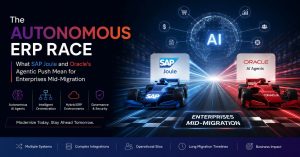
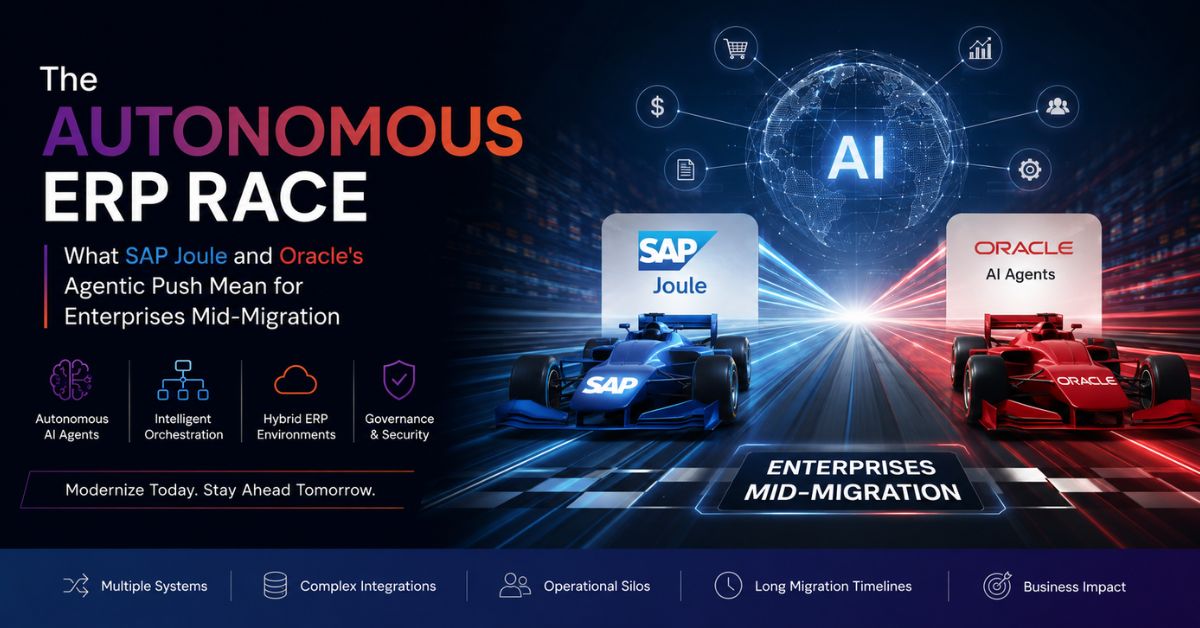
SAP is building this vision around Joule, while Oracle continues expanding AI agents across Fusion Cloud.
The opportunity is significant.
The challenge is equally significant.
Most enterprises are still somewhere in the middle of an ERP migration.
The New Competitive Battleground Is Not AI. It Is Autonomous Execution.
Traditional enterprise AI focused on helping employees work faster.
The new generation focuses on helping enterprises operate autonomously.
Instead of asking:
“What happened?”
Organizations are moving toward:
“Identify the issue, decide the best action, execute it, and inform me afterward.”
Examples include:
- Supply chain disruption automatically triggering supplier changes
- Finance agents matching invoices and approving payments
- Procurement agents creating purchase requisitions
- HR agents coordinating onboarding activities
- Manufacturing agents adjusting production schedules
This is a fundamental shift from workflow automation to autonomous business operations.
SAP’s Vision: The Autonomous Enterprise
SAP has made Joule the center of its enterprise AI strategy.
Rather than acting as a chatbot, Joule is becoming the conversational layer across SAP applications, connecting users with specialized AI agents capable of executing business processes across finance, HR, procurement, supply chain, and operations. Recent announcements have expanded SAP’s autonomous agent strategy significantly.
For organizations already investing in:
- SAP S/4HANA
- SAP Business Technology Platform (BTP)
- SuccessFactors
- Ariba
- SAP Analytics Cloud
the value proposition is compelling.
The deeper the SAP ecosystem, the more context Joule has available for intelligent execution.
Oracle Is Taking a Similar Path
Oracle is pursuing the same destination from a different starting point.
Its AI agents are deeply embedded within Oracle Fusion Cloud applications, enabling autonomous execution across finance, procurement, HR, supply chain, and customer operations. Like SAP, Oracle’s most advanced agent capabilities are designed around its cloud platform.
For organizations already running Oracle Fusion Cloud, this creates a highly integrated experience.
For Oracle E-Business Suite customers, however, accessing these capabilities generally requires broader modernization efforts.
The Reality for Enterprises Mid-Migration
This is where most CIOs find themselves today.
Their landscape often includes:
- SAP ECC
- SAP S/4HANA
- Oracle EBS
- Oracle Fusion
- Salesforce
- ServiceNow
- Microsoft
- Legacy manufacturing systems
- Custom applications
- Hundreds of APIs
Few enterprises operate inside a single vendor ecosystem.
Even fewer can complete ERP transformation overnight.
That creates an important question:
Should organizations delay AI adoption until ERP migration is complete?
For many enterprises, the answer is no.
Migration Should Not Become an AI Bottleneck
ERP modernization programs often span multiple years.
Waiting until every system reaches the cloud means delaying the operational benefits of AI.
Meanwhile:
- Manual approvals continue
- Supply chain disruptions remain reactive
- Finance teams still reconcile transactions manually
- Service teams work across disconnected systems
The business cost of waiting can be substantial.
Organizations increasingly want AI that works across today’s hybrid landscape rather than only tomorrow’s architecture.
A Different Approach: Agentic Automation Above the ERP Layer
Instead of replacing existing ERP investments, many organizations are adopting an orchestration layer that sits above enterprise applications.
This approach enables AI agents to coordinate work across:
- SAP
- Oracle
- Microsoft
- Salesforce
- Databases
- APIs
- Documents
- Legacy applications
without requiring immediate ERP replacement.
This allows enterprises to modernize business operations while continuing planned ERP transformation initiatives.
Where OnClik Fits
This is precisely the challenge OnClik Unified Agentic Automation (UAA) was designed to solve.
Rather than functioning as another isolated AI assistant, OnClik provides an enterprise orchestration platform that combines:
- Multi-agent AI
- Natural-language AI Copilot (Cortex)
- Visual workflow orchestration
- Enterprise integrations
- Governance and security
- Real-time analytics
The platform connects with ERP, CRM, databases, APIs, files, and enterprise applications, allowing autonomous processes to operate across heterogeneous environments instead of a single vendor stack.
For organizations migrating from SAP ECC to S/4HANA or Oracle EBS to Fusion Cloud, this enables immediate automation while protecting existing investments.
What CIOs Should Prioritize in 2026
The conversation should no longer focus solely on selecting an ERP vendor.
Instead, enterprise leaders should evaluate:
Can AI operate across our entire enterprise?
Not just within one application.
Does it support hybrid ERP environments?
Most organizations will operate hybrid landscapes for years.
Can it orchestrate multiple systems?
Enterprise processes rarely stay inside one platform.
Is governance built in?
Autonomous execution requires enterprise-grade controls, approvals, auditability, and security.
Can we realize value before migration finishes?
The highest-performing organizations are reducing manual work today instead of waiting for tomorrow’s architecture.
The Future Is Not Vendor AI. It Is Enterprise Orchestration.
SAP Joule and Oracle’s AI initiatives represent an important evolution in enterprise software.
They demonstrate that autonomous ERP is no longer theoretical.
It is becoming the next operating model for enterprise applications.
However, most enterprises will continue operating hybrid environments for the foreseeable future.
The organizations that move fastest will not necessarily be those that complete migration first.
They will be the ones that deploy intelligent orchestration across existing systems while modernizing at a pace that aligns with business priorities.
The future belongs not simply to autonomous ERP, but to autonomous enterprises that can coordinate people, systems, AI agents, and business processes regardless of where those systems reside.
That is where the greatest competitive advantage will be created.