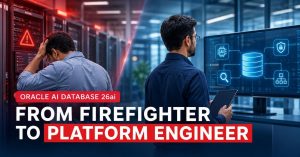
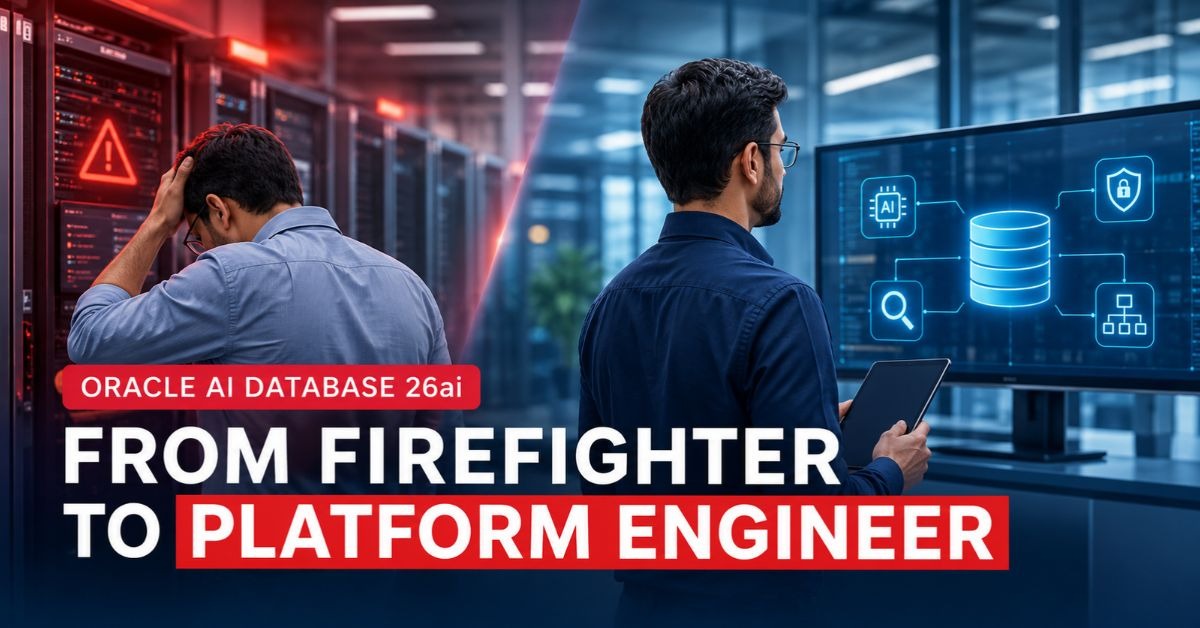
Every Oracle DBA knows the routine. A user reports that the system is slow, you open AWR and ASH reports, trace the problem to a SQL regression or resource contention, and apply a fix, usually after the business has already felt the pain.
Oracle AI Database 26ai does not make that routine disappear. What it changes is what the DBA’s job is for. With AI built into the database engine itself, the role is moving from reactive troubleshooting toward running a governed, AI-ready data platform.

What Oracle 26ai actually is
Oracle announced AI Database 26ai in October 2025 as a long-term support release that replaces Oracle Database 23ai. Oracle’s own documentation says it brings more than 300 new features, with a focus on AI and developer productivity. Headline capabilities include AI Vector Search, support for building and running AI agents inside the database, Model Context Protocol (MCP) server support, and a built-in SQL Firewall. Advanced AI features such as Vector Search are included at no additional charge.
How you get there depends on where you are today:
- On 23ai: Oracle says the move is a matter of applying a Release Update (the October 2025 RU, or RU 23.26.1 for on-premises Linux x86-64) rather than running a database upgrade. For packaged applications such as EBS, still check the application’s own certification.
- On 19c or 21c: Oracle supports a direct upgrade to 26ai from these two releases, using its AutoUpgrade tool. Databases on older releases such as 11.2.0.4, 12.1.0.2, 12.2 or 18c need an intermediate upgrade first, and in practice that means 19c, the long-term support release.
One caution: the way 26ai was delivered, as part of a patch set, caused some confusion. Rimini Street, a third-party support provider with its own commercial interests, argues that 23ai customers were told they would have to move to stay supported. Whatever your view, confirm the release and support timelines for your own environment in My Oracle Support before committing to a plan.
Five ways the DBA role is changing
1. From reactive tuning to exception-based management
Traditional performance work starts after a complaint. 26ai adds automation designed to act earlier. Automatic Transaction Rollback rolls back a lower-priority transaction that blocks a higher-priority one beyond a set timeout, and Real-Time SQL Plan Management detects plan regressions and reinstates a better earlier plan through a SQL plan baseline. Oracle’s Autonomous Health Framework also adds AI-powered anomaly detection and timeline analysis. These are features you configure and supervise, not a replacement for judgement. The DBA’s time shifts from hunting for the cause of every slowdown to handling the exceptions the system cannot resolve on its own, and to deciding priorities, timeouts and how much autonomy to allow in the first place.
2. From guarding a database to hosting AI workloads
Until now, many teams ran a separate vector store, built pipelines to keep it in sync with the transactional database, and layered a second security model on top. In 26ai, vector embeddings live natively alongside business data, and Unified Hybrid Vector Search combines similarity search with ordinary relational predicates in a single query. That removes moving parts, but it also puts new responsibilities on the DBA: vector index design, sizing the vector pool (the VECTOR_MEMORY_SIZE parameter), and the performance of AI queries running next to production transactions.
3. From perimeter security to in-database controls
SQL Firewall inspects statements before execution and blocks those that deviate from approved patterns, defending against SQL injection and unauthorized queries without a mid-tier proxy. 26ai also supports quantum-safe key exchange (ML-KEM) for TLS 1.3 connections. It is switched on through the TLS_KEY_EXCHANGE_GROUPS parameter, and at least one side of the connection must require it, otherwise ECDHE remains the default. Oracle’s roadmap shows similar TLS support coming to 19c through a Release Update, so this is not by itself a reason to upgrade. Someone has to own and maintain the approved SQL patterns and encryption settings, and in most organizations that someone is the DBA.
4. From single databases to a multitenant architecture
On 26ai, the container (CDB/PDB) architecture is mandatory: Oracle desupported the non-CDB architecture starting with 21c, so 26ai cannot run a non-CDB. If you still have non-CDB databases, they can be converted into PDBs inside a 26ai container database during the upgrade, but that conversion has to be scoped and planned, not treated as an afterthought. Skills like cloning, unplugging and plugging PDBs, and per-PDB resource monitoring move from “nice to have” to core.
5. From supporting applications to supporting agents
Oracle is pushing agentic AI closer to transactional data. In March 2026 it announced the AI Database Private Agent Factory, a no-code agent builder, and a Unified Memory Core that gives agents one store for context, along with Deep Data Security, which enforces end-user-based access rules in the database so that a user, or an AI agent acting for them, sees only what that user is allowed to see. Fusion Agentic Applications build on the same direction. These are newly announced capabilities, so confirm availability and maturity for your platform before planning around them. When agents can read and act on live data, the DBA becomes a natural owner of the controls around them: who can access what, how every access is audited, and how much resource an agent may consume.

What does not change
Backup and recovery, high availability, security fundamentals and sound performance engineering still matter. In some ways they matter more, because AI workloads raise the cost of an outage or a data leak. The point is not that DBA skills are being replaced. It is that the role is expanding to include AI-aware data architecture.
A practical readiness checklist
- Inventory your estate. Record database versions, non-CDB databases, and every application that depends on them, including Oracle E-Business Suite.
- Confirm certifications. Oracle has certified EBS 12.2 with 26ai for on-premises Linux x86-64 (starting with RU 23.26.1) and publishes certifications by Release Update for its cloud database services. Check the certified RU for your platform in My Oracle Support, run Oracle’s EBS Database Parameter Checker (EDBPC), and note that if you replicate EBS with GoldenGate, GoldenGate must also move to 26ai.
- Plan the CDB/PDB conversion first if any databases are still non-CDB.
- Test the upgrade with AutoUpgrade in a non-production copy, and review parameters such as COMPATIBLE: Oracle requires 23.4.0 or higher for the VECTOR data type and related features, and some newer vector features need a higher value, so check the Release Update notes.
- Define AI governance before go-live. Decide who can create vector indexes, call models or run agents, how SQL Firewall policies are managed, and how access is audited.
- Upskill the team in vector search concepts, AI workload performance, and exception-based monitoring.
Where Varchai fits
Upgrades like this are as much an operating-model change as a technical project. Varchai’s Remote DBA and Oracle EBS teams help organizations assess readiness, plan the CDB/PDB conversion and upgrade path, and run the resulting environment with day-to-day managed support, so internal teams can focus on the higher-value work that 26ai makes possible.
If you are weighing a move from 19c or 23ai, get in touch with our team for a readiness assessment.
The bottom line
Oracle 26ai turns the database into AI infrastructure. DBAs who embrace that shift, moving from firefighting to designing, governing and securing an AI-ready platform, will be central to how their organizations adopt AI safely. Those who treat it as just another patch cycle risk missing what it unlocks.