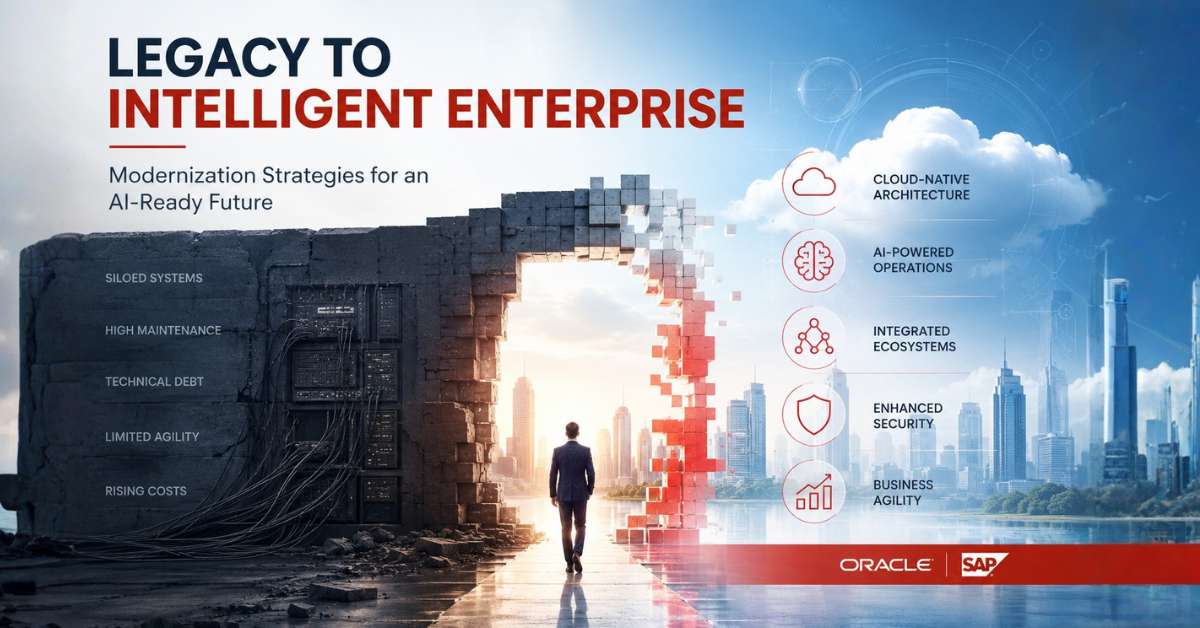
Enterprises worldwide are sitting on billions of dollars worth of aging infrastructure, COBOL mainframes, monolithic ERP deployments, on-premise Oracle EBS instances, and custom-built applications patched together over decades. These systems keep the lights on, but they also chain organizations to the past, blocking agility, inflating costs, and creating compounding technical debt. Legacy system modernization is no longer optional, it is the defining challenge of enterprise digital transformation.
Why Legacy Systems Persist, And Why That’s a Problem
The irony of legacy technology is that the very systems causing the most friction are often the ones no one dares to touch. Mission-critical processes, years of customisation, and institutional knowledge baked into undocumented workflows make legacy systems feel immovable. Fear of disruption wins over the promise of modernisation, until the cost of inaction exceeds the cost of change.
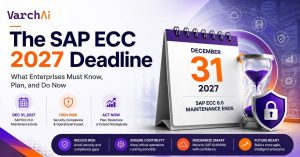
Common symptoms include difficulty integrating with modern APIs, inability to scale elastically, mounting security vulnerabilities, loss of vendor support (Oracle EBS on older releases, for example), and a growing skills gap as developers fluent in legacy stacks retire. For SAP customers, the 2027 end-of-mainstream-maintenance deadline for SAP ECC has crystallised urgency around S/4HANA migration.
Varchai perspective: “In our work with Oracle EBS and SAP ECC clients, the decision to modernise rarely comes from a single trigger. It is typically a confluence of a maturing maintenance window, a cloud mandate from leadership, and a competitive pressure that finally tips the equation.”
The Six Core Modernisation Strategies
There is no single right answer to legacy modernisation. Gartner’s classic “6 Rs” framework, Retire, Retain, Rehost, Replatform, Refactor, and Replace, provides a useful lens, but in practice, enterprise programs combine multiple approaches across their portfolio.
Retain
Keep stable, low-risk systems as-is while prioritising higher-impact modernisation elsewhere.
Rehost (Lift & Shift)
Move workloads to cloud infrastructure with minimal code changes, fast wins with limited transformation value.
Replatform
Migrate to a managed cloud service with targeted optimisations, e.g., moving Oracle DB to Oracle Cloud Infrastructure.
Refactor / Re-architect
Decompose monoliths into microservices or APIs. Higher effort, highest long-term agility payoff.
Replace
Swap the legacy system for a modern SaaS or custom solution, clean break, maximum disruption, maximum future value.
Retire
Decommission redundant or duplicate systems, often surfaces 20–30% of portfolio as immediate candidates.
ERP Modernisation: Oracle & SAP in Focus
ERP modernisation deserves its own focus because of the sheer complexity involved. Oracle and SAP landscapes in large enterprises are rarely clean, they carry years of bolt-on customisations, Z-reports, non-standard enhancements, and integrations with upstream and downstream systems that were never formally documented.
Oracle EBS to Oracle Cloud Fusion
The move from Oracle EBS (E-Business Suite) to Oracle Fusion Cloud is one of the most common modernisation journeys Varchai supports. It is not a technical upgrade, it is a business transformation. Fusion’s process-first architecture requires organisations to re-examine their workflows, often surfacing inefficiencies that were hidden inside customisations. The payoff is a subscription-based, continuously updated platform with native AI capabilities, including Oracle HCM Cloud’s skills inference and Oracle EPM Cloud’s scenario modelling.
Key decisions in this journey: adopt standard vs. retain customisations, phased rollout vs. big-bang cutover, and data migration strategy, particularly for historical transactional data that must be preserved for compliance or reporting.
SAP ECC to S/4HANA
SAP’s S/4HANA migration is driven by hard deadlines: mainstream maintenance for SAP ECC 6.0 ends in 2027 (with extended support to 2030 at additional cost). Organisations face a choice between Greenfield (clean-slate S/4HANA implementation), Brownfield (in-place system conversion), and Bluefield (selective data migration). SAP SuccessFactors for HCM and SAP Ariba for procurement are typically decoupled and migrated ahead of the core S/4HANA programme, de-risking the overall timeline.
| Migration Path | Advantages | Challenges |
|---|---|---|
| Greenfield | Clean slate, best-practice processes, future-proof architecture | High effort, full re-implementation, long timeline |
| Brownfield | Preserves data & customisations, faster to go-live | Carries forward technical debt, harder to simplify |
| Bluefield | Selective migration, business continuity during cutover | Complex orchestration, requires specialist tooling |
Data Migration: The Hidden Complexity
No modernisation programme fails more often at the data layer than anywhere else. Data quality issues, inconsistent master data, missing historical records, and misaligned field mappings create delays that cascade into cost overruns. A structured data migration approach, assess, cleanse, map, load, validate, is non-negotiable.
Varchai’s SAP Data Migration practice uses a combination of SAP Data Services, LSMW, and BAPI-based custom loaders depending on volume and complexity. For Oracle migrations, Oracle Data Integrator (ODI) and FBDI (File-Based Data Import) are the primary tools. In both cases, iterative trial loads starting 6–9 months before cutover are the single most effective risk mitigation available.
Rule of thumb: Budget at least 25–30% of total programme effort on data migration and master data governance. Organisations that underinvest here account for the majority of delayed go-lives.
Integration Architecture in a Modernised Landscape
Modern ERP platforms are designed to be integrated, not siloed. Oracle Integration Cloud (OIC) and SAP Integration Suite provide iPaaS capabilities that replace point-to-point integrations with a managed, observable integration layer. Designing this layer correctly, with proper API governance, event-driven patterns, and error handling, is as important as the core ERP migration itself.
Common integration patterns in post-modernisation landscapes include REST API-based real-time integration for operational data, batch/file-based integration for bulk loads, event streaming (Kafka or Oracle Streaming) for near-real-time propagation, and middleware-free direct integrations where platforms offer native connectors (e.g., SuccessFactors to Oracle HCM coexistence scenarios).
Building a Modernisation Roadmap
A modernisation roadmap is not a technology plan, it is a business plan with technology as its instrument. The most effective roadmaps start with business outcomes and work backwards to technical enablers.
-
Portfolio Assessment Catalogue all systems, classify by business criticality and technical debt. Identify quick retire candidates (typically 20–30% of the portfolio).
-
Business Case Development Quantify total cost of ownership for legacy systems vs. target state. Include licensing, infrastructure, maintenance, and productivity costs.
-
Strategy Selection Apply the 6Rs framework per system, factoring in complexity, integration dependencies, and vendor roadmaps.
-
Sequencing & Wave Planning Sequence migrations to manage business risk, typically Finance first, then Supply Chain, then HR and extended modules.
-
Change Management Programme Invest in user adoption early. Change resistance, not technology failure, is the leading cause of modernisation programme setbacks.
-
Hypercare & Optimisation Plan a 3–6 month hypercare period post go-live with dedicated support resources. Optimisation begins once stabilisation is complete.
AI as the Accelerator
The modernisation wave and the AI wave are arriving simultaneously, and organisations that align them will capture disproportionate value. Modern ERP platforms now embed AI natively: Oracle HCM Cloud uses machine learning for skills gap analysis and attrition prediction; Oracle EPM Cloud applies AI-assisted forecasting; SAP S/4HANA embeds intelligent automation in Accounts Payable and Procurement.
Beyond in-platform AI, Varchai’s OnClik platform extends agentic automation across the modernised enterprise, automating repetitive business processes, orchestrating workflows across Oracle and SAP environments, and connecting departmental systems into a unified operational layer. Modernisation creates the clean data foundation that AI requires to deliver measurable outcomes.
The Time to Act Is Now
Legacy system modernisation is a multi-year programme, not a project. The organisations that begin structured assessment today will be operating on modern, AI-ready platforms while competitors are still funding increasingly expensive maintenance of systems that limit their ability to respond to market change.
Whether the starting point is an Oracle EBS assessment, an SAP ECC to S/4HANA roadmap, a remote DBA consolidation, or a bespoke application replacement, the journey benefits from partners with deep functional and technical expertise across the full spectrum of enterprise transformation.
Varchai brings over ten years of enterprise technology delivery, Oracle, SAP, custom development, and AI-powered automation, to help organisations navigate this transformation with confidence.