For two decades, enterprise technology strategy has centered on a single question: should an organization standardize on one ERP, or operate with several? By 2026, that framing has largely become moot. Most large enterprises already run SAP and Oracle in parallel, often alongside a long tail of custom applications, regional systems, and platforms inherited through acquisition. The more pressing question for CIOs today is how to make these systems work together intelligently, without disrupting what already functions.
This is the problem “sidecar” architectures are designed to solve, and why they are emerging as one of the defining integration patterns of the year.
What Is a Sidecar Architecture?
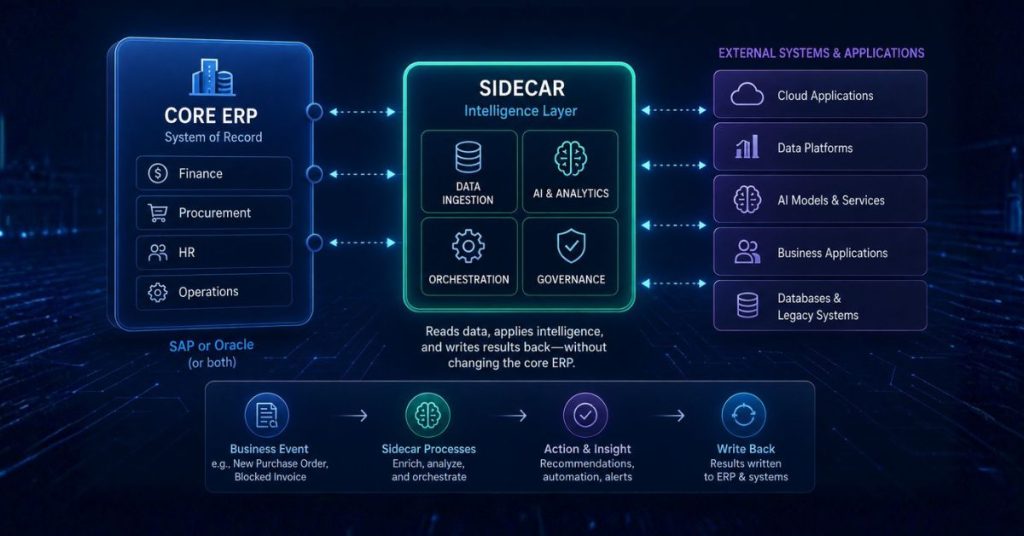
The term originates from microservices design: rather than rebuilding or replacing a core system, organizations attach a smaller, purpose-built companion system alongside it. The core ERP, whether SAP or Oracle, remains in place and continues to function as the system of record for finance, procurement, HR, and operations. The sidecar operates alongside it, reading data, applying intelligence, and writing results back, without altering the underlying ERP configuration.
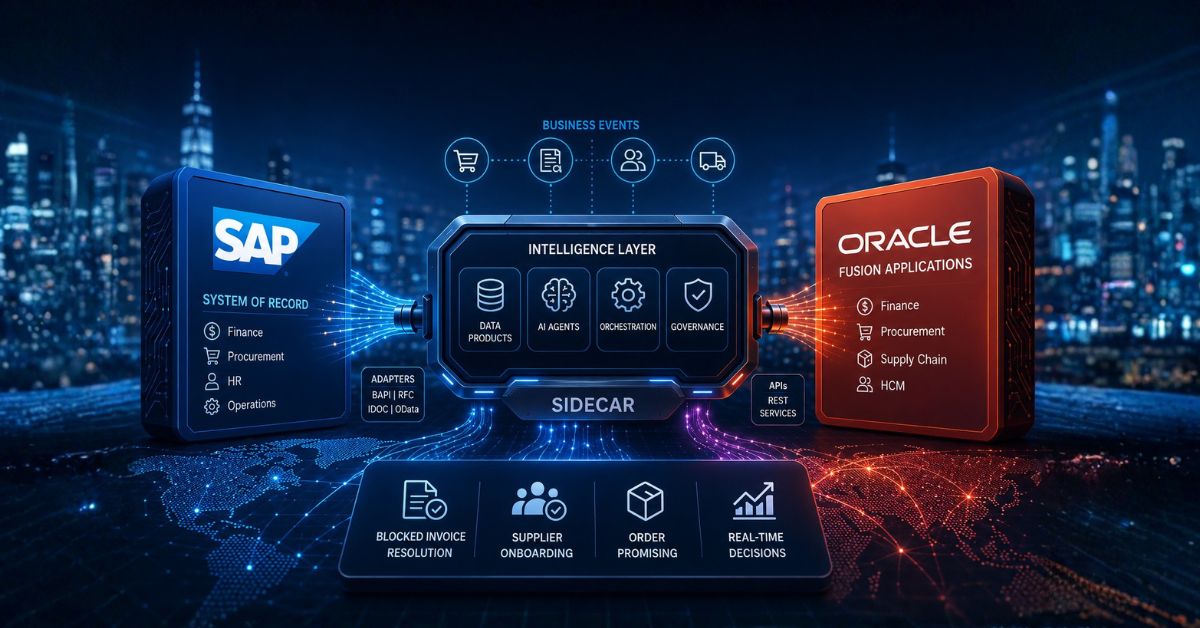
Oracle has formalized this pattern through a documented architecture that pairs its AI Data Platform with Fusion Applications, specifically designed to operate alongside existing SAP environments. The model is built around an orchestrator that routes business events, such as a new purchase order, a blocked invoice, or a supplier update, to specialized agents and tools. These agents can read from and write to both SAP (through adapters connecting to BAPI, RFC, IDoc, or OData business objects) and Fusion Applications (through REST APIs), curating that data into governed “data products” before any AI-driven action is taken.
In practice, this enables a single intelligence layer to operate across systems that were never designed to communicate directly.
Why This Pattern Is Gaining Traction
Several forces are converging to drive adoption of this model.
Hybrid ERP estates have become the norm. Mergers, acquisitions, regional rollouts, and decades of incremental IT decisions mean most enterprises now operate more than one ERP, whether by design or by circumstance. Replacing these systems is costly, risky, and slow. A sidecar allows organizations to capture value from AI and automation without committing to a multi-year migration program.
Real-time decision-making cannot wait for batch processing. The traditional model of nightly file transfers between systems is no longer adequate for how businesses operate. If a supplier delays a shipment in the morning, a production schedule needs to reflect that change within minutes, not after the next overnight batch run. Event-driven, API-led integration is what makes this possible, and it is the foundation on which sidecar architectures are built.
High-friction, cross-system problems are now addressable. Some of the most persistent pain points in hybrid environments are well defined: blocked invoices that remain unresolved because finance and procurement data reside in different systems, supplier onboarding processes that require manual reconciliation of vendor records across platforms, and order promising that depends on demand and supply signals scattered across SAP and Oracle. Sidecar architectures are designed specifically for these scenarios, drawing data from both systems, applying AI-driven recommendations, and writing results back safely.
Composability is emerging as the guiding architectural principle. There is growing recognition that no single platform, however capable, should be expected to do everything. Organizations leading transformation efforts are designing around clean API contracts, where the ERP remains the transactional backbone while specialized AI, data, and automation layers operate around it. Tightly coupled, monolithic landscapes are increasingly viewed as a future liability rather than a current advantage.
The Data Quality Prerequisite
None of this functions without clean underlying data. AI-driven automation across SAP and Oracle environments requires critical fields to be more than 95% complete, with formats standardized across modules. This is often the least visible part of the project, yet it determines whether a sidecar delivers trustworthy outputs or simply automates inconsistency at greater speed.
Organizations evaluating this approach should treat a data readiness assessment as a prerequisite to any architecture decision, not a follow-on task.
A Broader Pattern, Not a Single Vendor’s Roadmap
Sidecar thinking extends beyond any one vendor’s strategy. Across the ERP landscape, similar patterns are being applied to establish trust and audit layers (pairing ERPs with permissioned ledgers for provenance and compliance), to enable natural-language access to existing databases, and to bridge ERP systems of record with specialized planning engines that handle complexity ERPs were never designed to manage, such as factory floor scheduling or supply chain re-planning.
At the same time, some vendors are moving in the opposite direction for specific functions, such as commerce, arguing that capabilities once added as sidecars should eventually be brought natively into the core. This tension between sidecar and native integration is likely to play out differently across the enterprise stack. Finance and HR cores are likely to remain stable for the foreseeable future. Intelligence, orchestration, and cross-system automation represent the areas where the sidecar model has the greatest room for growth.
Implications for Organizations Running Hybrid SAP and Oracle Environments
The practical implication is straightforward: organizations do not need to choose between SAP and Oracle, nor wait for a multi-year consolidation program to begin realizing value from agentic AI and automation. A well-designed sidecar layer can operate across both environments today, automating the cross-system processes that have historically consumed time and resources.
The organizations that move first will not necessarily be those with the largest IT budgets. They will be the ones that treat their hybrid ERP estate as an asset to orchestrate, rather than a problem to resolve through eventual consolidation.
For organizations running SAP, Oracle, or both, and considering how an orchestration layer could connect these environments without disrupting existing operations, this represents a timely architecture conversation.