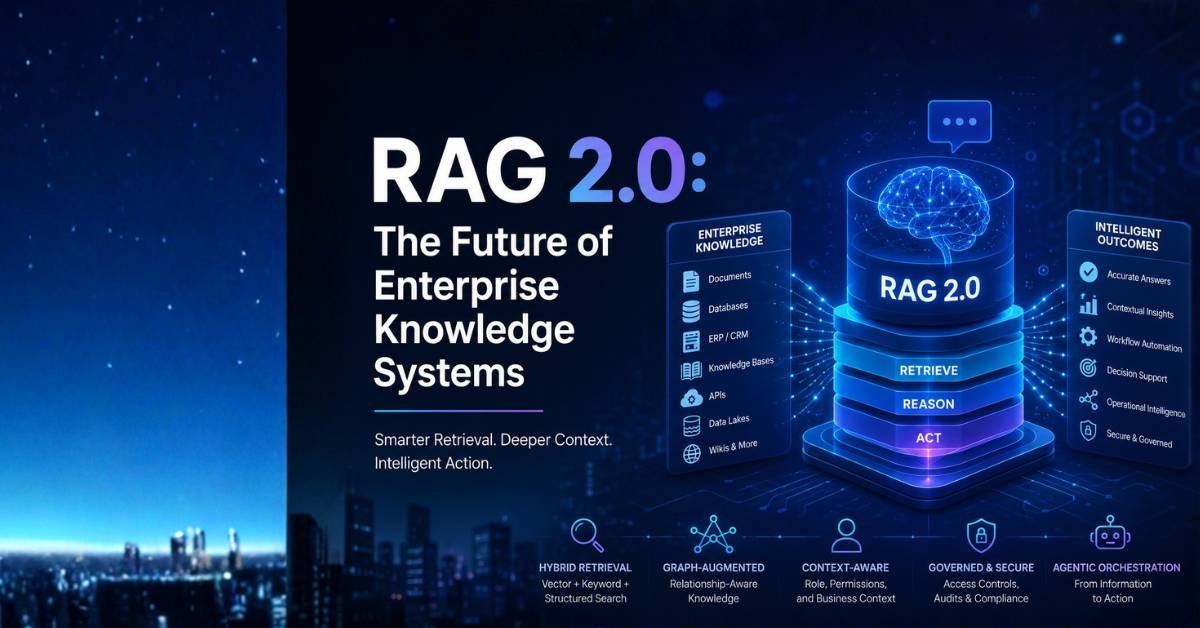
Artificial Intelligence is entering a new enterprise era.
Organizations are no longer experimenting with AI solely through isolated chatbots or standalone copilots. Enterprises are now building intelligent systems capable of retrieving institutional knowledge, understanding operational context, supporting decision-making, and increasingly orchestrating business workflows.
At the center of this evolution is Retrieval-Augmented Generation (RAG).
RAG has rapidly become one of the foundational architectures for enterprise AI because it allows Large Language Models (LLMs) to interact with real organizational knowledge instead of relying only on static training data.
However, as enterprise AI adoption matures, organizations are discovering that basic RAG pipelines alone are often insufficient for complex operational environments.
This has led to the emergence of more advanced architectures that many in the industry are informally referring to as “RAG 2.0.”
While there is no single standardized definition for RAG 2.0, the term generally describes the evolution of RAG systems into more intelligent, context-aware, governed, and operational enterprise knowledge architectures.
What Is RAG?
Retrieval-Augmented Generation (RAG) combines two core capabilities:
1. Retrieval
Fetching relevant information from external knowledge sources such as:
- Enterprise documents
- Databases
- ERP systems
- APIs
- Knowledge bases
- CRMs
- Data lakes
- Internal wikis
2. Generation
Using Large Language Models (LLMs) to generate contextual responses grounded in the retrieved information.
Unlike traditional generative AI systems that rely primarily on pre-trained knowledge, RAG enables AI systems to work with current and organization-specific information.
This significantly improves:
- Accuracy
- Context relevance
- Real-time information access
- Explainability
- Enterprise usefulness
In simple terms, standard LLMs generate responses based on training data.
RAG systems generate responses using your organization’s actual knowledge.
Why Enterprises Are Moving Beyond Basic RAG
Early enterprise RAG implementations focused primarily on document retrieval and conversational interfaces.
These systems proved highly valuable for:
- Enterprise search
- Internal assistants
- Knowledge discovery
- Customer support augmentation
- Document summarization
However, as organizations expanded AI adoption into operational environments, several limitations became increasingly apparent:
- Fragmented enterprise data
- Inconsistent retrieval quality
- Limited contextual awareness
- Weak multi-step reasoning
- Minimal workflow integration
- Governance and security challenges
- Difficulty handling structured and unstructured data together
Importantly, these limitations do not mean traditional RAG is obsolete.
Basic RAG remains highly effective for many enterprise use cases today.
However, more advanced enterprise environments increasingly require systems capable of:
- Understanding business context
- Reasoning across multiple data sources
- Maintaining operational continuity
- Enforcing governance policies
- Integrating with enterprise workflows
- Supporting intelligent automation
This is where next-generation RAG architectures are emerging.
What Many Enterprises Are Calling “RAG 2.0”
The term “RAG 2.0” is not yet an official industry standard.
Instead, it broadly refers to the evolution of retrieval systems into more adaptive and enterprise-aware AI architectures.
Different vendors and researchers describe these architectures differently, including:
- Agentic RAG
- GraphRAG
- Adaptive RAG
- Hybrid RAG
- Multi-agent retrieval systems
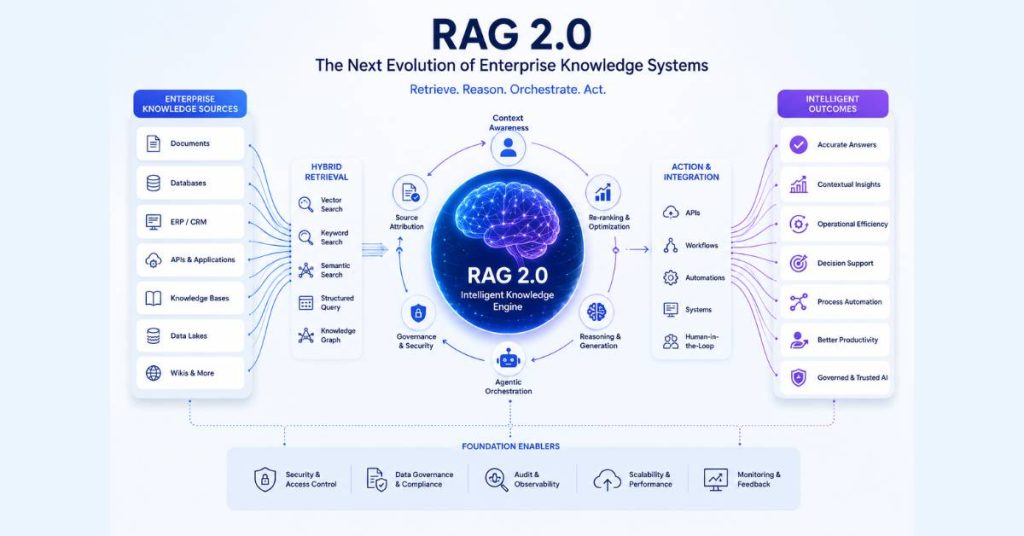
Despite varying terminology, most advanced enterprise RAG systems increasingly share several common characteristics:
- Hybrid retrieval architectures
- Context-aware reasoning
- Structured and unstructured data integration
- Knowledge graph augmentation
- Retrieval optimization and re-ranking
- Governance and access control enforcement
- Agentic orchestration capabilities
- Real-time enterprise connectivity
- Human-in-the-loop validation
Rather than functioning solely as search assistants, these systems increasingly operate as intelligent enterprise knowledge layers.
The Key Components of Advanced Enterprise RAG Systems
1. Hybrid Retrieval Architecture
Enterprise information exists across multiple disconnected systems:
- SAP
- Oracle
- Salesforce
- SharePoint
- Emails
- APIs
- PDFs
- Ticketing platforms
- Data warehouses
- Collaboration tools
Modern enterprise RAG systems increasingly combine:
- Vector search
- Keyword search
- Metadata filtering
- Structured database queries
- Semantic retrieval
- Knowledge graphs
This hybrid approach improves retrieval accuracy and business relevance.
Instead of retrieving only semantically similar information, systems can retrieve contextually appropriate enterprise knowledge.
2. Context-Aware Intelligence
Basic RAG systems retrieve information primarily based on semantic similarity.
Advanced enterprise systems increasingly incorporate:
- User roles
- Permissions
- Organizational hierarchy
- Historical interactions
- Workflow state
- Operational context
For example, two employees asking the same question may receive different responses based on:
- Department
- Security permissions
- Business responsibilities
- Current operational context
This transforms retrieval systems from generic assistants into enterprise-aware intelligence systems.
3. GraphRAG and Relationship-Aware Retrieval
One of the most important developments in enterprise AI is the rise of GraphRAG.
GraphRAG combines vector retrieval with knowledge graphs to improve:
- Relationship understanding
- Multi-hop reasoning
- Entity connections
- Context preservation
Traditional vector retrieval may identify similar documents.
Graph-based retrieval can additionally understand how enterprise entities are connected, such as:
- Customers
- Contracts
- Vendors
- Systems
- Transactions
- Organizational structures
This is particularly valuable for complex enterprise environments where relationships between data points matter as much as the data itself.
4. Retrieval Optimization and Re-Ranking
Modern enterprise RAG systems increasingly use retrieval optimization techniques such as:
- Re-ranking models
- Contextual compression
- Query rewriting
- Adaptive retrieval pipelines
These techniques improve response quality by prioritizing the most relevant and trustworthy information before it reaches the language model.
As enterprise datasets scale, retrieval quality becomes one of the most critical success factors for AI accuracy.
5. Governance, Security, and Source Attribution
Governance is becoming a foundational requirement for enterprise AI adoption.
Organizations cannot deploy AI systems that:
- Expose sensitive information
- Ignore enterprise permissions
- Produce unverifiable outputs
- Operate without accountability
Advanced RAG architectures increasingly include:
- Role-based access controls
- Source attribution
- Citation tracing
- Audit logging
- Compliance enforcement
- Human approval workflows
This is especially critical in highly regulated industries such as:
- Banking
- Healthcare
- Government
- Insurance
- Telecommunications
Enterprise AI systems must not only be intelligent.
They must also be secure, transparent, and trustworthy.
6. The Rise of Agentic RAG
Another major evolution is the growing intersection between RAG and agentic AI systems.
Traditional RAG systems primarily retrieve and generate information.
Agentic AI systems can additionally:
- Execute workflows
- Use enterprise tools
- Trigger automations
- Coordinate across systems
- Perform multi-step reasoning
- Support operational decision-making
This has led to the emergence of “Agentic RAG” architectures, where retrieval systems are integrated into broader orchestration frameworks.
In these environments, RAG serves as the knowledge foundation that powers AI agents capable of taking contextual actions.
This represents an important shift:
from AI systems that simply provide information
toward systems that can actively support enterprise operations.
Enterprise Use Cases for Advanced RAG Systems
Intelligent Enterprise Search
Employees can retrieve accurate answers across:
- ERP systems
- Policies
- Technical documentation
- Contracts
- Support tickets
- Internal knowledge bases
without manually navigating multiple disconnected systems.
AI-Augmented Customer Support
Support teams can use enterprise RAG systems to:
- Retrieve contextual resolutions
- Summarize historical interactions
- Recommend next actions
- Improve ticket routing
- Access real-time operational information
Enterprise Decision Intelligence
Executives and analysts can interact with operational data using natural language.
Instead of relying solely on static dashboards, organizations can build conversational intelligence systems capable of:
- Explaining trends
- Identifying anomalies
- Generating operational summaries
- Supporting strategic analysis
Intelligent Process Automation
When integrated with orchestration platforms, enterprise RAG systems can support:
- Document understanding
- Contextual workflow decisions
- Knowledge-driven automation
- Human-in-the-loop approvals
This creates more adaptive forms of intelligent process automation.
Challenges Enterprises Still Need to Solve
Despite rapid progress, implementing enterprise-scale RAG systems remains challenging.
Key issues include:
Data Fragmentation
Enterprise knowledge is often distributed across disconnected systems and formats.
Data Quality
Poorly governed data reduces retrieval accuracy and AI reliability.
Security and Compliance
AI systems must enforce enterprise permissions and regulatory requirements.
Infrastructure Scalability
Large-scale retrieval pipelines require optimized architecture and performance management.
Organizational Readiness
AI transformation requires operational and governance changes, not just technical implementation.
Successful enterprise AI adoption depends on aligning technology, governance, and organizational processes.
Why Advanced RAG Architectures Matter Now
Several industry shifts are accelerating adoption:
- Enterprise AI maturity is increasing
- LLM capabilities are rapidly improving
- AI agents are becoming operationally viable
- Organizations require trustworthy AI systems
- Enterprise knowledge complexity continues to grow
- Employees increasingly expect conversational interfaces
- Businesses are seeking automation at scale
Importantly, the future of enterprise AI will not depend solely on larger language models.
It will depend on better knowledge systems.
The Future of Enterprise Knowledge Systems
Enterprise software is gradually evolving from application-centric architecture toward knowledge-centric architecture.
In this model:
- Enterprise knowledge becomes interconnected
- AI becomes the interaction layer
- Systems become increasingly composable
- Intelligence becomes operationalized
Advanced RAG architectures are becoming a critical bridge between:
- Enterprise data
- AI reasoning
- Human decision-making
- Operational workflows
Over time, organizations are likely to move toward unified AI-driven interfaces capable of interacting across multiple enterprise systems through a single intelligent layer.
This shift has the potential to significantly improve:
- Productivity
- Knowledge accessibility
- Decision-making
- Operational agility
- Enterprise efficiency
Final Thoughts
RAG has rapidly become one of the foundational architectures of enterprise AI.
As organizations move beyond simple AI assistants toward operational intelligence systems, retrieval architectures are evolving to become:
- More contextual
- More governed
- More connected
- More adaptive
- More operationally integrated
Although “RAG 2.0” is not yet a formally standardized term, it reflects an important industry direction:
the transition from basic retrieval pipelines toward intelligent enterprise knowledge systems capable of supporting real-world business operations.
The future of enterprise AI will not rely solely on generative capabilities.
It will increasingly depend on how effectively organizations can retrieve, govern, reason over, and operationalize enterprise knowledge at scale.